Laneway guide
Hosier Lane is a street that happens to be painted
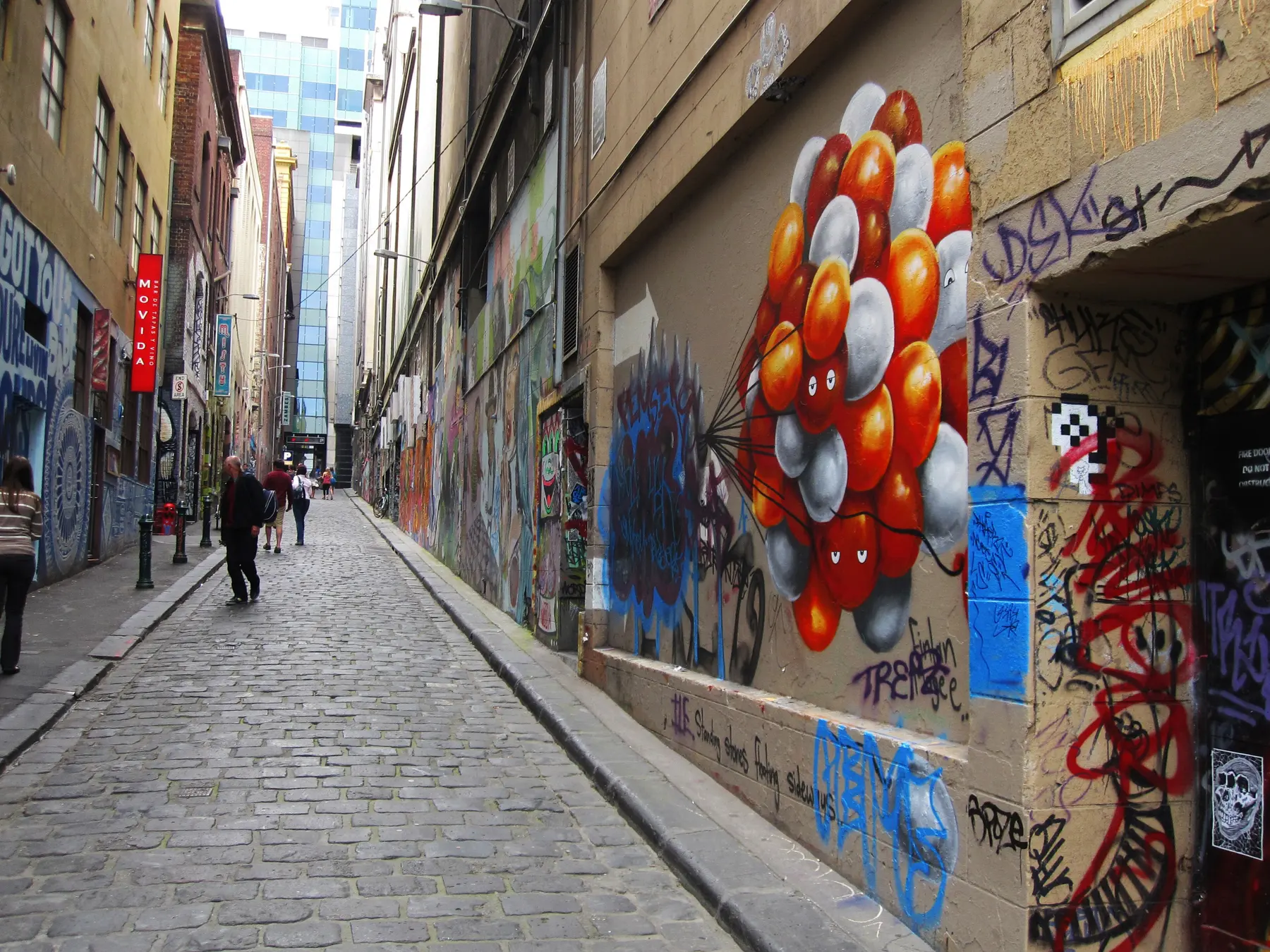
Hosier Lane runs between Flinders Street and Flinders Lane on the south-eastern side of the Hoddle Grid. People come for street art that changes. The lane remains a public thoroughfare with the same rules as any other city laneway.
Hosier Lane is one of the few Melbourne laneways that visitors can name before they land. That fame is a mixed gift. It keeps the walls in conversation. It also invites people to treat a working alley as a set. This guide is here to put the lane back into the street plan, and to keep this domain from inventing a street-art mythology it cannot source.
The lane runs roughly north–south between Flinders Street and Flinders Lane, a short walk from Federation Square and St Paul’s Cathedral. It is part of the city’s ordinary cadastral fabric. You do not buy a ticket. You do not pass a turnstile. You share the space with people who work, deliver, live upstairs, or are just cutting through.
What you are actually looking at
Street art on these walls is impermanent by design. Pieces are painted over, tagged, weathered, or removed. A photograph from last year is a historical document, not a wayfinding tool. That is the honest attraction: a public surface that does not pretend to be a permanent collection.
This guide will not attribute a wall to a named artist unless a primary institution is doing the attributing on the day you read it. Artist reputations and “biggest mural in the lane” claims are how visitor copy slides into invented rankings. Look. Do not collect names you cannot verify.
ACDC Lane, nearby, is a separately named laneway with its own civic naming story (the band AC/DC). It is not a second Hosier Lane and it is not a concert venue just because of the name. Walk it as a street.
How to get there without a tour script
From Flinders Street Station, walk east along Flinders Street toward Spring Street, or cut via Federation Square and the cathedral side. From Federation Square, the lane is a short walk; you do not need a shuttle. From a tram on Flinders or Swanston, use PTV’s stop names and, if you ride, the Free Tram Zone rules.
This paragraph is deliberately not a turn-by-turn clone of City of Melbourne’s published laneway walks. Those walks are civic products with their own voice. Use a current map.
What is allowed, and what people pretend is allowed
Looking, photographing without blocking the lane, and walking through are ordinary public uses.
What is not ordinary, and should not be assumed from the presence of paint:
- Adding your own work
- Scraping, peeling or “taking a piece”
- Climbing to a higher wall or onto a canopy
- Flying a drone between buildings
- Setting up a paid shoot that occupies the lane as if you hired it
Permission, when it exists, comes from property owners, any current City of Melbourne program, or a private arrangement — not from a visitor guide. If you cannot find a current official page that says you may paint, you may not paint.
Commercial film and photography sometimes need permits in Melbourne’s centre. That is a civic process. This site will not guess the fee.
Crowds, safety, and the unromantic bits
The lane is narrow. Mid-morning tour groups and weekend afternoons fill it. You can still walk through; you may not get a clear photograph, and that is not a failure of the city.
Surfaces can be uneven. Paint and paste make footing worse in rain. There is no requirement that a famous laneway also be a playground. Keep bags close, as you would in any crowded street. This is not a crime briefing and not a promise of pastoral calm.
Loading docks and private doors are still in use. Standing in a roller-door opening for a photograph is how visitors become a problem for someone trying to work.
Night
After dark the lane is still a public street. Lighting, crowds and nearby venues change the feel. This guide will not invent a closing time because streets do not close like shops. It will say: if you would not linger in an unfamiliar alley at home, apply the same judgement. Pair night plans with a main-street exit to Flinders or Federation Square.
Nearby rooms that reset the eye
Fame-fatigue is real. After Hosier Lane, walk to:
- Federation Square — civic terrace, different scale
- Ian Potter Centre: NGV Australia — indoor art with wall labels that do not change overnight in the same way
- St Paul’s Cathedral — a different kind of interior
- Degraves Street — a different kind of lane, more café than mural
That reset is why this site’s laneways hub insists on two families of space. Paint, then stone. Alley, then arcade.
Tours, apps, and “street art trails”
Third-party tours will meet at the mouth of the lane. Some are careful about history and permission. Some are a selfie convoy. This domain will not pick one. If you book, read cancellations and whether the price includes anything other than talking in a public street.
Apps that pin “best murals” go stale for the same reason paper guidebooks go stale: the walls move. Use your eyes.
What this page will not do
It will not embed a live mural map. It will not quote a visitor. It will not claim Hosier Lane is the “best street art in the world” or even the best in Melbourne. Comparative rankings are marketing. The citeable claim is smaller and better: this is a public CBD laneway where people have, for years, put work on walls that other people then walk past.
If you came from an old spam URL on this hostname, you are in a rewritten city guide. The lane was never those articles’ subject, and those articles are gone.
How the lane sits in a photographed city
Hosier Lane is one of the most photographed pieces of public ground in the centre. That is not the same as being the most important. The State Library, the river and the station clocks carry more civic weight. The lane carries a particular kind of attention: close, colourful, vertical. If your only CBD memory is a wall, you have used the city as a backdrop. If the lane is one room among three, you have used it as a street.
Photographers should know that other people are also trying to walk. A standing portrait in the centre of the lane at noon is a temporary roadblock. Early morning is quieter; this is an observation, not a crowd statistic and not a promise.
Weather, light, and the myth of the perfect wall
Midday sun flattens paint. Overcast days are easier on cameras and on skin. Rain makes the bluestone and the paste slick. None of those sentences are “best time to visit” marketing. They are why a plan that requires a perfect mural photograph is a fragile plan. Build the day so that the lane can fail and the library or an arcade can still work.
Neighbouring alignments, without a trail brand
East of the lane you move toward Spring Street, Parliament and Treasury Gardens. West and south you are back at Federation Square and the station. North, Flinders Lane continues as a longer street with buildings that are not murals. ACDC Lane is a short additional walk, not a level in a game. Hardware Lane is a different quarter. Do not let a map app stitch all of them into a “street art trail” that this site did not write.
Legal and cultural notes, kept modest
Graffiti and street art sit in a live argument between property law, council programs, and practice on the wall. This guide is not legal advice. It is not a how-to. It will not explain techniques. It will not list paint shops. If you are an artist looking for a legal wall, use current City of Melbourne or property-owner channels, not a visitor page.
Some works on laneway walls engage with political or cultural material, including Aboriginal cultural themes. Looking is one thing. Treating those works as a costume or a joke is another. Wurundjeri Country is not a filter.
Families
Children often like the colour. The lane is still a roadway grain with uneven ground and occasional language on walls that you may not want to explain. Prams fit badly when the lane is full. There is no age policy because it is a street. Use the judgement you would use in any crowded alley.
If you only remember one instruction
Walk through. Look up as well as sideways. Leave the walls as you found them. Then go somewhere that is not a corridor — a square, a reading room, a garden — so that Melbourne’s centre is not reduced to a single painted slot.
At a glance
- Public laneBetween Flinders Street and Flinders Lane
- Art changesWalls are not a permanent exhibition
- No ticketLooking is free; painting is not automatic
What people always ask
What is Hosier Lane?
Hosier Lane is a public Melbourne CBD laneway known for frequently changing street art. It is not a museum, not a ticketed experience, and not an open wall for visitors to paint without permission.
Can I do a street-art tour there?
Independent guides and commercial tours use the lane because it is public. This site does not endorse an operator or invent a duration. If you join a tour, read that operator’s inclusions.
Pair the lane with an arcade
Hosier Lane is open-air paint. The Royal and Block Arcades are nineteenth-century interiors. They are a better contrast than walking three more painted lanes in a row.
Heritage arcades